
Cocoa pods contain 20-60 beans depending on variety. Learn how Criollo, Forastero, and Trinitario differ, plus what affects bean count in each pod.
How many cocoa beans does it take to make your chocolate bar? If you're like most people who enjoy eating chocolate, you've probably never considered the question. Yet the answer reveals why chocolate remains one of the world's most labour-intensive crops – and why prices continue rising.
I've always known that producing chocolate requires numerous cocoa pods, but I'd never investigated the specifics until recently. During one of our chocolate courses, a student asked what seemed like a simple question: "How many beans are there in a cocoa pod?" I realised I didn't have a precise answer.
So, I thought that in todays blog post I'll look into the complete mathematics of cocoa production – how many pods per tree, beans per pod, and trees needed for a single bar of chocolate.
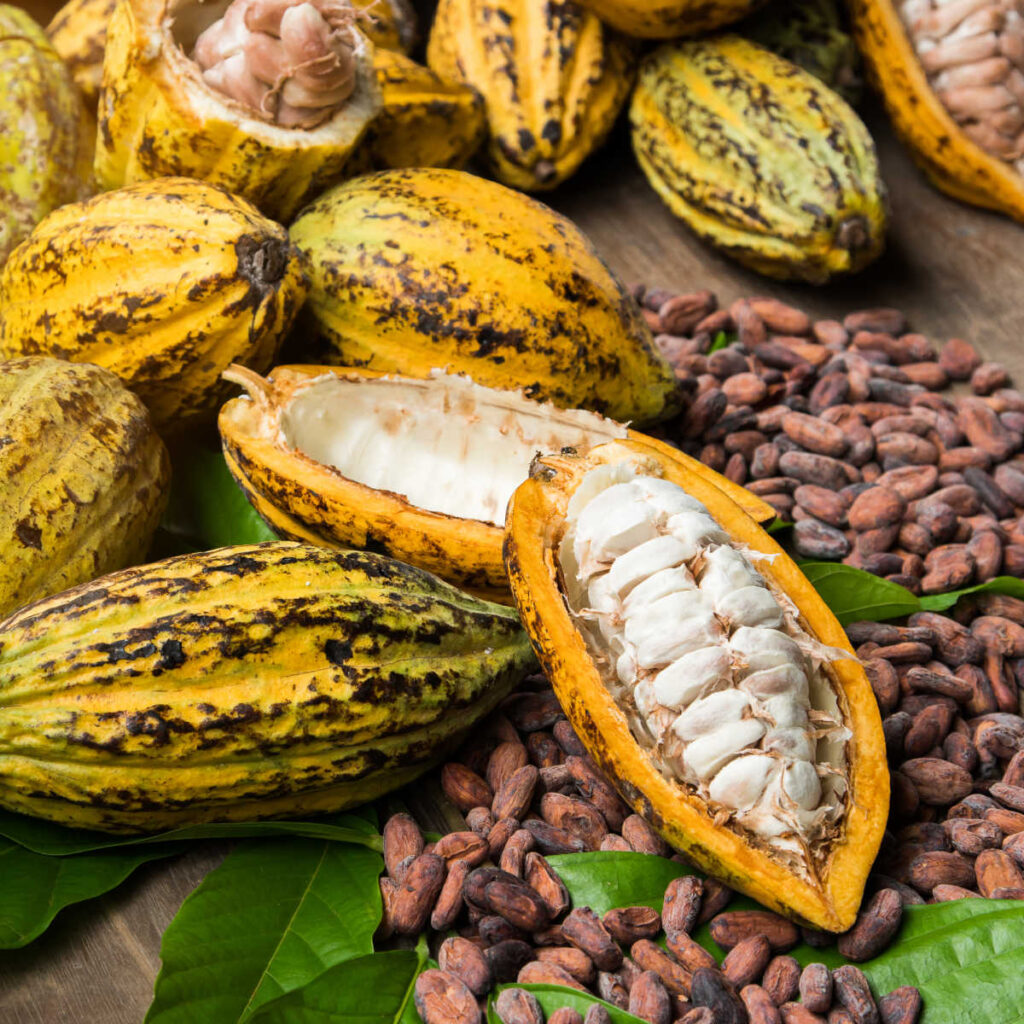
The Direct Answer: It's Complicated (But Here's What You Need to Know)
The short answer: The simple answer is that most cocoa pods contain between 20 and 60 seeds, with the typical pod averaging around 30 to 40 beans. But here's the honest truth, it varies quite a bit, and even pods growing on the same tree can contain very different numbers of seeds.
The honest answer: It depends on numerous factors, and even pods from the same tree can vary significantly.
The answer ranges from exceptional lows around 12 beans in stressed or wild varieties to remarkable highs approaching 67 beans in perfectly optimised Forastero varieties—but most pods you'd encounter fall somewhere in the comfortable middle ground of 30 to 40 beans.
What makes this variation truly fascinating isn't just the range of numbers but what it tells us about cocoa as a crop. Unlike wheat or rice where modern agriculture has engineered remarkable uniformity, cocoa remains wonderfully, frustratingly, beautifully unpredictable. Every pod is slightly different, every cocoa tree has its own personality, and farmers must work with nature's variability rather than against it.
That unpredictability is part of what makes chocolate special—and what keeps it labour-intensive, expensive, and utterly irreplaceable.
What You'll Find Inside a Fresh Cocoa Pod
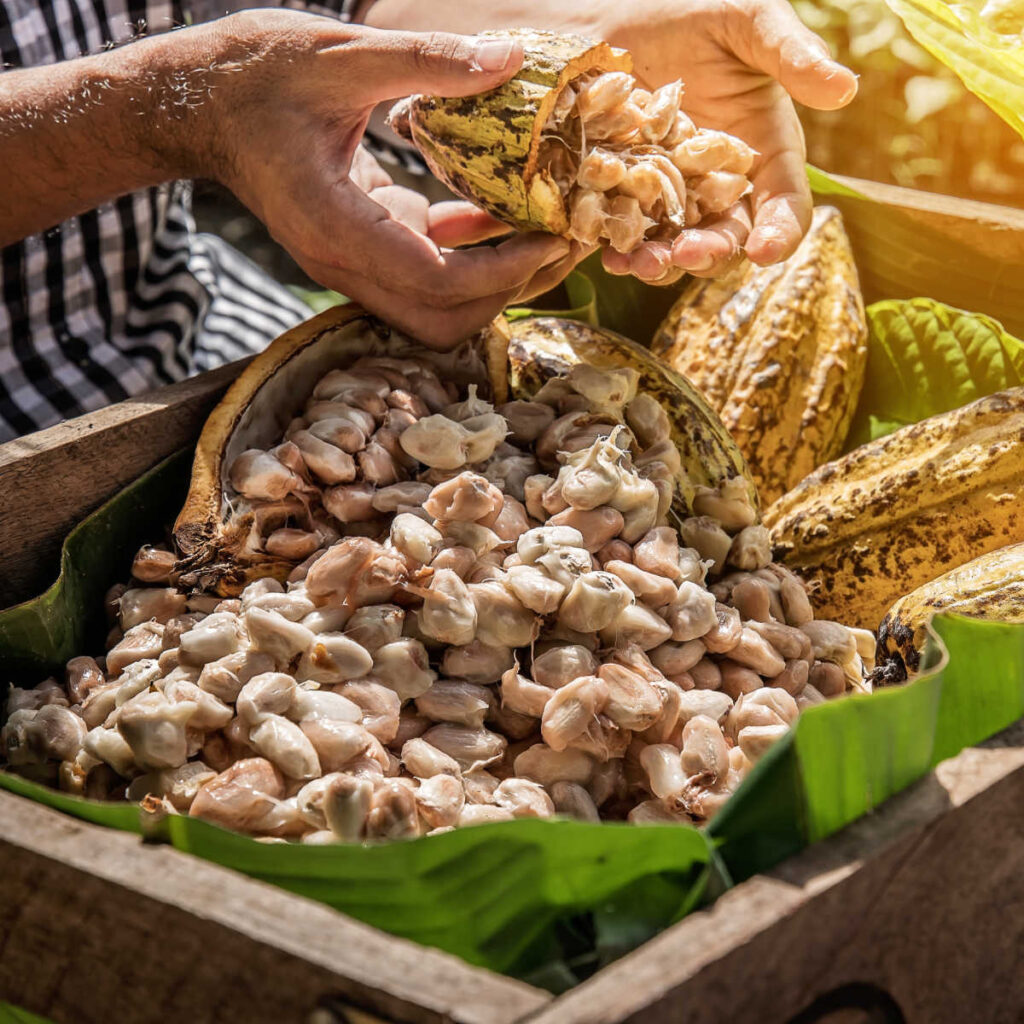
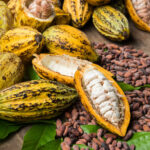
When you open a fresh cocoa pod—which takes a sharp blade and considerable effort through the thick woody shell—you'll discover something quite remarkable. The cocoa beans are arranged in five neat rows running lengthways inside the cocoa pod. These almond-shaped seeds sit snugly in a sweet white pulp that tastes surprisingly like lychee or mango, nothing at all like chocolate.
The beans themselves measure about 2 to 3 centimetres long and roughly 1 to 1.5 centimetres wide, though this varies considerably. Some pods contain plump, fat beans whilst others hold flatter, thinner seeds.
This variation isn't random—it's determined by the type of tree, where it's growing, and how well it's been cared for. A farmer might open ten pods from the same tree and count anywhere from 28 to 45 beans in each one.

The Type of Cocoa Tree Makes the Biggest Difference on the bean count
The single most important factor determining bean count is which variety of cocoa tree produced the pod. There are three main types, and each has distinctly different characteristics.
Criollo: The Rare and Precious Type (20-30 beans per pod)
Criollo pods actually contain the fewest beans of any variety—typically just 20 to 30 per pod. These rare trees represent less than 5% of the world's cocoa production, yet they're considered the finest variety available.
What Criollo lacks in quantity, it makes up for in quality. The beans are larger and rounder than other types, with colours ranging from pure white to pale ivory or very light purple. They produce chocolate with delicate, complex flavours featuring notes of nuts, caramel, and subtle fruitiness.
These trees are quite fragile and susceptible to disease, which is why they're primarily grown in their native regions of Central and South America, particularly Venezuela, Ecuador, and parts of Mexico. The lower bean count reflects the tree's strategy of producing fewer but superior seeds.
Forastero: The Workhorse Variety (30-50 beans per pod)
Forastero accounts for roughly 80 to 85% of the world's cocoa production, and it's easy to see why. These hardy trees produce more beans per pod than any other variety—typically 30 to 40 beans, sometimes reaching as high as 50 in particularly productive pods.
However, Forastero beans look quite different from Criollo. They're flatter and more compressed, typically deep purple or dark brown in colour. The beans are smaller individually but far more numerous. Interestingly, a Forastero pod might actually weigh about the same as a Criollo pod despite containing more beans, because each individual bean is smaller.
The flavour is more robust and bitter, with earthy, woody notes and less complexity than Criollo. This strong chocolate taste makes Forastero ideal for mass-market chocolate production. The variety is most widely cultivated in West Africa—particularly Côte d'Ivoire, Ghana, and Nigeria—as well as Brazil and Indonesia.
These trees are much tougher than Criollo, with harder pod shells that better protect the beans from pests and disease. This resilience is the main reason Forastero dominates global production.
Trinitario: The Best of Both Worlds (25-45 beans per pod)
Trinitario emerged in Trinidad during the 18th century when devastating disease wiped out the island's delicate Criollo plantations. The few surviving Criollo trees naturally cross-pollinated with hardy Forastero varieties, creating a hybrid that combined desirable traits from both parents.
Bean count in Trinitario pods varies considerably—anywhere from 25 to 45 beans per pod—because the variety itself is genetically diverse. Some Trinitario trees lean more heavily towards their Criollo heritage, whilst others express more Forastero characteristics.
The beans display remarkable colour variation, ranging from pale purple through various shades to nearly white. This colour diversity within a single pod is actually a distinctive Trinitario feature.
The flavour sits somewhere between the delicate complexity of Criollo and the robust intensity of Forastero, making Trinitario popular amongst craft chocolate makers who want interesting flavour without sacrificing tree hardiness or bean yield. These trees are widely cultivated in the Caribbean, Cameroon, Papua New Guinea, Ecuador, and Peru, representing about 10 to 15% of world production.
Quick overview of the most used types of beans and their bean count
| Variety Type | Bean Count Range | Average | % World Production |
|---|---|---|---|
| Criollo | 20-30 | 24 | <5% |
| Forastero | 30-50 | 38 | 80-85% |
| Trinitario | 25-45 | 35 | 10-15% |
| Modern Hybrids | 30-55 | 40 | Growing % |

Cocoa Bean Varieties with Seed Counts Per Pod
The Three Primary Genetic Groups
1. Criollo ("Native")
Seeds per pod: 20-30 beans
Subvarieties:
- Porcelana (Venezuela): 20-25 beans | Pure white to pale ivory beans, considered the finest Criollo
- Chuao (Venezuela): 22-28 beans | Pale purple to white beans, grown in the legendary Chuao region
- Ocumare (Venezuela): 20-28 beans | Light purple beans with exceptional flavor complexity
- Criollo de Cacao (Mexico): 22-30 beans | Traditional Mexican variety, pale beans
- Pentágona (Various origins): 20-28 beans | Named for distinctive five-sided pod shape
- Guasare (Venezuela): 22-28 beans | Rare variety with white to very pale purple beans
- Carmelo (Peru): 24-30 beans | High-quality Peruvian Criollo with light-colored beans
Characteristics: Lowest bean counts but largest individual bean size; fragile trees; susceptible to disease; represents <5% of world production.

2. Forastero ("Foreign")
Seeds per pod: 30-50 beans
Subvarieties:
Amelonado Group (Lower Amazon):
- Amelonado (West Africa, Brazil): 35-45 beans | Smooth, melon-shaped yellow pods; backbone of African production
- Cundeamor (Ecuador): 32-42 beans | Warty, ridged pods; robust flavor
- Calabacillo (Various): 30-40 beans | Small, round pods; compact bean arrangement
Contamana Group (Upper Amazon):
- Contamana (Peru): 35-48 beans | Long, pointed pods; high productivity
- Iquitos (Peru): 38-50 beans | Highly productive variety with high bean counts
- Purus (Brazil): 35-45 beans | Hardy Amazonian variety
- Nanay (Peru): 36-48 beans | Common in northern Peru; reliable production
Nacional (Ecuador - technically Forastero):
- Arriba Nacional (Ecuador): 28-38 beans | Lower bean count than typical Forastero; prized "Arriba" flavor with floral notes
- CCN-51 (Ecuador): 40-55 beans | Controversial high-yield hybrid; maximum bean count but criticized for inferior flavor
Other Forastero Types:
- Catongo (Brazil): 32-40 beans | Rare yellow-bean mutation
- Parazinho (Brazil): 35-45 beans | Common Brazilian variety
- Comum (Brazil): 33-43 beans | General cultivated Forastero type
Characteristics: Highest bean counts; smallest individual bean size; hardy and disease-resistant; represents 80-85% of world production.

3. Trinitario (Criollo × Forastero Hybrid)
Seeds per pod: 25-45 beans
Regional Populations:
Caribbean Trinitario:
- Trinidad Selected Hybrids (TSH): 30-42 beans | Scientific breeding program varieties
- Imperial College Selections (ICS): 28-40 beans | Multiple numbered selections (ICS 1, ICS 6, ICS 95, etc.)
- Jamaican Trinitario: 28-38 beans | Traditional Caribbean cultivation
- Grenada Trinitario: 30-40 beans | Distinctive island population
Central/South American Trinitario:
- Java Trinitario: 32-42 beans | Introduced to Indonesia from Trinidad
- Ceylon Trinitario (Sri Lanka): 30-40 beans | Asian adaptation
- Matina (Costa Rica): 28-38 beans | More Criollo-leaning traits
- Scavina (Peru): 30-42 beans | Important breeding parent; vigorous growth
African Trinitario:
- Amelonado × Trinitario crosses (Cameroon): 32-45 beans | African-adapted populations
- Upper Amazon Hybrids (Ghana/Nigeria): 35-45 beans | Higher bean counts, more Forastero influence
Modern Breeding Selections:
- SCA 6, SCA 12 (Peru): 30-40 beans | Scavina selections
- EET Series (Ecuador): 28-42 beans | Ecuadorian National Collections
- PA Series (Brazil): 32-44 beans | Brazilian agricultural research selections
- POUND Series (Trinidad): 28-38 beans | Named after F.J. Pound who collected them
Characteristics: Highly variable bean counts depending on genetic makeup; wide color variation (white to dark purple); combines disease resistance with quality; represents 10-15% of world production.

Modern Hybrids & Research Cultivars
High-Yield Hybrids
- CCN-51 (Ecuador): 40-55 beans | Maximum productivity; commercial focus
- TSH Series (Trinidad): 30-42 beans | Disease-resistant breeding selections
- CATIE-R Series (Costa Rica): 28-40 beans | Central American breeding program
- IMC-67 (Trinidad): 32-42 beans | Witches' broom resistant
- SCA-6 (Peru): 30-40 beans | Selected for black pod resistance
Fine Flavor Cultivars
- Beniano (Bolivia): 25-35 beans | Rare Bolivian wild type
- Chuncho (Peru): 28-38 beans | Traditional Peruvian variety
- Porcelana (Venezuela): 20-25 beans | Lowest bean count, highest quality
- Guasare (Venezuela): 22-28 beans | Ultra-rare white bean variety

Wild & Indigenous Types
Amazon Basin Wild Types
- Marañón Canyon (Peru): 24-32 beans | Recently "rediscovered" ancient variety
- Ucayali (Peru): 30-40 beans | Wild riverside populations
- Beni Wild (Bolivia): 25-35 beans | Isolated Bolivian forest populations
- Curaray (Ecuador): 28-38 beans | Wild Ecuadorian types
Characteristics: Extreme genetic diversity; bean counts highly variable even within populations; often used in breeding programs for disease resistance and novel flavors.

Pod Size and Maturity Also Matter
Beyond the tree variety, the physical characteristics of individual pods significantly influence how many beans they have.
Larger pods generally—but not always—contain more beans simply because there's more space inside. Cocoa pods typically measure 15 to 25 centimetres long and 8 to 12 centimetres across, roughly the size of a small rugby ball. However, size isn't everything. Sometimes a large pod will be filled with excess pulp rather than beans, whilst a compact, dense pod might pack an impressive number of well-formed beans into a smaller space.
Harvest timing is crucial too. Cocoa pods harvested before reaching full maturity usually have fewer fully developed beans. Under-ripe pods might look the right colour on the outside but have incompletely formed seeds inside and some beans may be small or flat rather than plump and viable. This is why farmers learn to assess ripeness not just by colour but by gently shaking the pod; a ripe one produces a distinctive hollow rattle.
On the other hand, over-ripe pods left too long on the tree don't contain more beans, but the beans may have begun sprouting inside the pod, making them useless for chocolate production.

Growing Conditions Affect Bean Count
The environment where a cocoa tree grows profoundly influences how many beans develop in each pod.
Soil quality makes a real difference. Trees growing in nutrient-rich soil produce pods with higher bean counts and better-formed individual beans. Depleted soils result in pods where many potential bean sites simply fail to develop properly, leaving gaps in the five rows of seeds. Well-fertilised sections of plantations consistently produce fuller pods than areas with poor soil.
Water matters throughout pod development. Consistent rainfall during the five to six months from pollination to maturity is crucial for maximum bean count. Water stress during critical development periods can cause some embryonic beans to abort, reducing the final count.
Tree age affects productivity. Young trees producing their first pods often have lower bean counts as the tree is still establishing itself. Mature trees in their prime produce the fullest pods with maximum bean counts, whilst older trees beyond peak productivity may still make pods but often with declining bean counts.
Disease and pests take their toll. Several diseases can reduce bean development inside pods, including black pod disease and frosty pod rot, which can damage or prevent beans from forming properly. The cocoa pod borer, a devastating insect pest in Asia, tunnels into pods and damages developing beans, effectively reducing the viable bean count even if the original number was high.

Why This Matters for Chocolate Production
I think, that understanding bean counts helps to explain why chocolate production is so labour-intensive and why prices keep rising.
A typical 100 g bar of dark chocolate requires approximately 40 to 45 beans—roughly the contents of one to two pods. This means thousands upon thousands of pods must be hand-harvested, carefully opened, and processed to produce chocolate on a commercial scale.
I always found it fascinating, that each tree produces only about 20 to 40 pods per year, and each pod takes five to six months to mature after the flower is pollinated. This means, that only a tiny fraction of the thousands of flowers a tree produces actually develop into pods.
When you realise that a single chocolate bar represents the carefully tended work of multiple trees over several months, the price of quality chocolate suddenly makes much more sense.

The Smallest Viable Pods (12-15 beans)
The lowest recorded bean count in a mature, viable cocoa pod appears to be around 12 to 15 beans. These disappointingly sparse pods typically occur in very young trees producing their first crop (sometimes called "maiden pods") or trees suffering from severe nutrient deficiency or drought stress.
Very low count pods can be also affected by disease during early development that managed to mature despite the damage. And there are also certain wild Criollo varieties in their native Central American habitats that have naturally low cocoa beans count.
Saying that, pods with fewer than 20 beans are generally considered commercially unviable. Farmers opening pods and finding such low counts know immediately that something is wrong—either with that particular tree's health or with the growing conditions that season.
Interestingly, some ancient wild cocoa populations in isolated Amazonian regions naturally produce smaller pods with bean counts consistently in the 15 to 22 range. These aren't diseased or stressed trees—this is simply their genetic baseline. Researchers studying these wild populations believe this represents what cocoa pods looked like before centuries of human cultivation selected for higher bean counts.
The Largest Recorded Pods (67 beans)
On the opposite extreme, the highest documented bean count I could find in published research is an extraordinary 67 beans in a single pod. This remarkable specimen was recorded in an Indonesian research station growing a particularly vigorous Forastero variety under optimal conditions.
However, such extreme counts are exceptionally rare. Agricultural researchers in Ecuador working with the high-yield CCN-51 variety—which was specifically bred for maximum productivity—report occasional pods reaching 55 to 60 beans, though even this requires perfect growing conditions.
The catch with these super-productive pods is that the individual beans are often quite small. A pod with 60 beans doesn't necessarily yield more chocolate than a pod with 35 larger beans—it's the total weight of dried cocoa that matters for production, not just the count.
The cocoa pods with missing beans
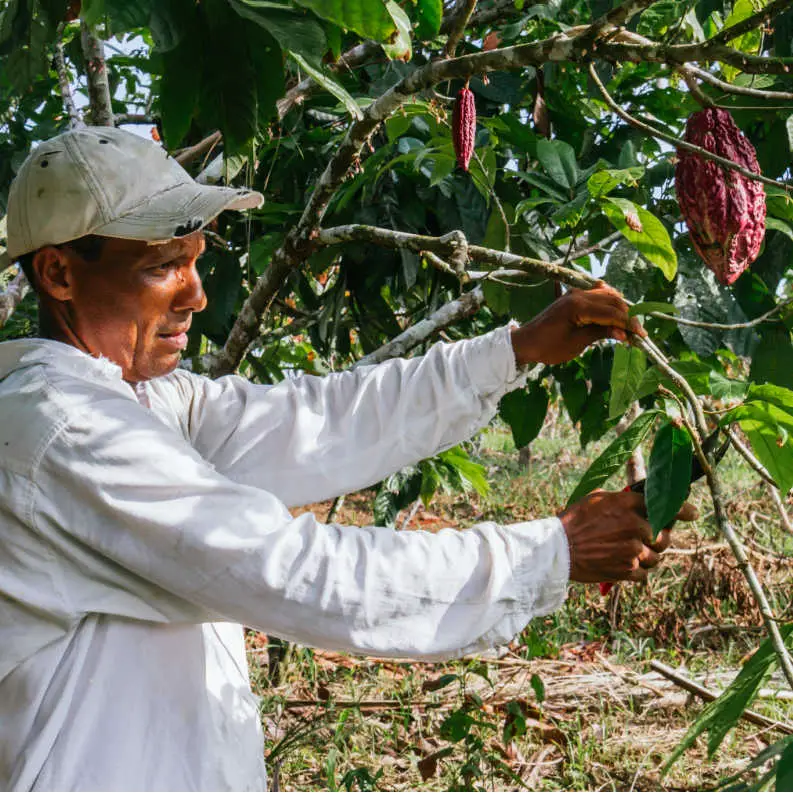
Farmers occasionally encounter what they call gap-toothed pods, where the five rows of beans have conspicuous empty spaces where beans failed to develop. Opening these pods reveals a peculiar pattern: perhaps three or four beans, then a gap, then five beans, another gap, then two beans, and so on.
These gaps represent ovules that were fertilised initially but aborted during development, often due to a specific stress event like a brief drought or nutrient shortage at a critical moment. The surviving beans develop normally, creating this distinctive gappy pattern. Experienced farmers can actually estimate when during the growing season a stress event occurred based on where the gaps appear in the rows.

Statistical Quirks in Bean Distribution
Remember how beans are arranged in five rows? Mathematically, this means bean counts that divide evenly by five should be most common—15, 20, 25, 30, 35, 40, and so on. However, research analysing thousands of pods found something unexpected: bean counts aren't evenly distributed across these multiples.
The most frequently occurring count isn't a neat multiple of five at all—it's 37 beans. The next most common counts are 34, 38, 36, and 41. Research suggests this happens because the five rows don't develop uniformly; some rows consistently produce one or two more beans than others, creating this skewed distribution.
The same tree variation study
A fascinating study in Trinidad tracked a single Trinitario tree over an entire harvest season, opening and counting beans in every single pod the tree produced—142 pods in total. The results were remarkable:
- Smallest pod: 23 beans
- Largest pod: 46 beans
- Average: 34.7 beans
- Standard deviation: 5.8 beans
That's a 23-bean range of variation from the same tree in the same year under virtually identical conditions. This single tree demonstrated more variation than the entire average difference between Criollo and Forastero varieties. It beautifully illustrates why giving precise bean counts for cocoa pods is genuinely difficult—nature simply doesn't do precision.
The Mystery of Sequential Pods
Another curious observation from long-term studies. I found out that, pods growing immediately adjacent to each other on the trunk often have remarkably similar bean counts, even when overall tree variation is high. It's fascinating to learn, that pods separated by just 5 to 10 centimetres frequently differ by only one to three beans.
Researchers speculate this happens because adjacent pods share the same local vascular connections for nutrient supply, so they experience nearly identical growing conditions. Meanwhile, a pod on the opposite side of the trunk might differ by 15 beans because it's drawing from a different nutrient pathway.

Cultural Beliefs and Superstitions
I found out that in some cocoa-growing regions, farmers have developed elaborate superstitions around bean counts.
In parts of Ghana, finding a pod with exactly 40 beans is considered highly auspicious—some farmers keep one bean from such pods as a good luck charm. In Ecuador, pods containing fewer than 25 beans are sometimes left unopened and placed at the base of the tree as an offering to encourage better production.
Venezuelan farmers growing Criollo sometimes refer to pods with 25 or more beans as "generosa" (generous) and those with fewer than 22 as "tacaña" (stingy), attributing personality traits to individual trees based on typical pod counts.
In Madagascar, there's a charming tradition where children learning to harvest cocoa are challenged to guess the bean count before opening each pod. The child who comes closest after ten pods receives a small prize. This teaches young harvesters to assess pod quality by external features—weight, shape, sound when tapped—skills that prove valuable throughout their careers.
The Economics of Bean Count
I think, it's also interesting to look at how the bean count in each cocoa pod directly affect each cocoa farmer. Here's a sobering calculation that illustrates why bean count genuinely matters to farmers' livelihoods:
A farmer with trees averaging 35 beans per pod, producing 30 pods per tree per year, with 100 trees, harvests: 35 × 30 × 100 = 105,000 beans annually.
If that same farmer could increase average bean count by just 5 beans per pod—to 40 beans average—without changing anything else: 40 × 30 × 100 = 120,000 beans annually.
That's an additional 15,000 beans (14% increase) without planting a single additional tree or using more land. At typical yields, this translates to roughly 100 to 150 kilogrammes more dried cocoa beans to sell—a meaningful increase in income for a smallholder farmer.
This is why agricultural research stations spend considerable resources trying to develop cocoa varieties with reliably higher bean counts, and why farmers pay close attention to which trees consistently produce fuller pods, sometimes grafting from those superior tree specimens.
This blog post was originally written on 25 November 2016 and last updated on 10 February 2026



Leave a Reply