
The 1940s is one of the most transformative decades in confectionery history. The era was split by World War II, which forced manufacturers to pivot from luxury treats to durable military rations. Sugar and cocoa shortages meant that many civilian sweets disappeared from shelves, while others—like M&M's—were engineered specifically to survive the heat of battle.
When the war ended in 1945, a sugar rush followed. Companies used new industrial technologies developed during the war to mass-produce sweets with longer shelf lives and bolder, synthetic flavours. By 1949, the industry had shifted from small-scale candy shops to the global brands that still dominate the market today.
MORE SWEETS & CHOCOLATES HISTORY
Wartime sweets rationing
After the declaration of war in September 1939, three groups of food were initially rationed in January 1940; sugar, bacon and butter. This was followed by meat, fish, tea, jam, biscuits, breakfast cereals, cheese, eggs, milk and canned fruit. Many factories were converted into making munitions for the war effort.
Sweet rationing came into effect in 1942. There was an Allowance of seven ounces (200 gms) for everyone over five years old. This was the equivalent of just one sweet a day for most products in the Woolworth's range. By the following year, sweets were becoming scarce and even having sufficient coupons was no guarantee that there would be enough sweets in the shops to buy.
In summer 1940, Cadbury's were assuring customers that their chocolate biscuits were available in all stores. Three years later, they ran adverts in Picture Post magazine, saying that supplies were severely limited and asking customers to remember that growing children needed the nutrition from milk chocolate the most.
As raw materials were in short supply, chocolate manufactures were forced to substitute products and improvise ingredients. For instance, Cadbury Dairy Milk as withdrawn in 1941 when the government banned manufacturers from using fresh milk. In its place there was Ration Chocolate Bar, made with dried skimmed milk powder, which I'm sure you won't find on your favourite list of chocolate bars these days.
The ration chocolate bar
In ‘A Child of War’, written in 1987, the author George Macbeth reminisced that sweets were the great loss and had his own firmly held views on the dubious taste of Ration Chocolate.
‘There was no longer an everlasting, teeth-spoiling fountain of sherbet and liquorice, or of Boy Blue cream whirls, or of Cadbury's Caramello. Sweets were hard to come by, and then limited to a fixed ration.
One of the worst casualties was chocolate. The traditional division into milk and plain disappeared, and an awful intervening variety known as Ration Chocolate was born, issued in semi-transparent grease-proof wrappers, and about as appetizing as cardboard. In spite of a lifelong sweet tooth, I could never eat it.’
What production of chocolate that did occur was strictly on a geographical basis due to transport restrictions and the need to ration petrol supplies. So, if you liked something made by Rowntrees of York and you lived in London then tough luck.
Chocolate bars on the home front & in the war
So much for chocolate and the lack of it on the home front. You were more likely to get your hands on a bar of chocolate, however variable its quality, if you were in the army. The US army, to be more precise. Yes, those WW2 films of Yanks in battledress, chewing gum, and wooing the local land girls with supplies of delicious chocolate and sweets not found in the British shops are largely true.
However, like some of their other promises, it appears that the chocolate didn’t always live up to expectations…
MORE SWEETS HISTORY
- The best chocolate bars & sweets from the 1930s >>
- Wartime Sweets & Chocolate History in UK & USA >>
D ration chocolate bar
The “D ration bar”, was a blend of chocolate, sugar, cocoa butter, skim milk powder and oat flour, made by Hershey. It was an essential part of the emergency rations issued to US troops as part of the D day invasion of the beaches of Normandy. It weighed four ounces (112 grams) with 600 calories, was designed to be high in energy for mobile field operations and was manufactured to withstand high temperatures. Due to the fact that the recipe didn’t allow it to liquefy sufficiently, Hersheys had to design and make special chocolate moulds.
All of which made it difficult it eat and with a taste that isn’t fondly remembered by most.
Reports are that the mix of fat and oat flour made the chocolate bar a dense brick, and the sugar could not hide the extremely bitter taste to the dark chocolate. Designed to withstand high temperatures, the bar was difficult to bite into. Soldiers resorted to slicing off shaving of chocolate with their field knife.
For those of you interested in the actual ratios of ingredients, the formula for a large batch of the D chocolate ration bars, was 160 parts chocolate, not less than 54 percent cocoa fat, 160 parts added cocoa fat, 30 parts oat flour, 20 parts dry powdered skim milk, 70 parts vanillin crystals, and just enough sugar to make it palatable.
These days there the amount of sugar in chocolate is much higher, mainly because it's cheaper than cocoa mass and other cocoa ingredients.
The ration chocolate bar also had one-sixth part vitamin B1, which may have been healthy but didn’t add to the overall flavour. This could be considered as a pretty healthy probiotic chocolate in it's day, although not the tastiest.
Chocolate bars had a waxy or greasy taste which may have due, in part to the increase in the melting point from 92 to 120 degrees Fahrenheit. Bars came with instructions that they were to be eaten in small quantities over a half hour period, (which was perhaps just as well) or could be dissolved in boiling water.
In fairness to Hershey, one of the US army’s other stipulations was that the chocolate bar should taste ‘a little better than a boiled potato!’. It seems that the army wanted a bar that didn’t taste so good that it was eaten as a treat and therefore not conserved for emergencies. No wonder US troops used to refer to it as ‘Hitler’s Secret Weapon’.
However, the combination of ingredients and taste requirements did have one unexpected benefit. The Tropical bar, specially designed to withstand the intense heat of the tropics and the desert, came into its own as practically the only foodstuff that soldiers in the Far East could eat when they were ill with dysentery.
The sheer scale of chocolate production for the military is staggering. By war’s end, Hershey had made while around 40.2 million 2-ounce and 4-ounce D Ration bars, and 380 million Tropical Chocolate Bars – that’s a lot of cure for dysentery.
The war may have ended in 1945 but chocolate and sweet rationing didn’t. It was to be another long eight years until 5 February 1953 before the 12 ounces a month ration was finally abolished. Sugar itself was not de-rationed until September 1953.
Suddenly, there were more queues but this time without the need for coupons.
MORE SWEETS HISTORY
- Chocolate & Sweets in the 1950s + list of the best ones >>
- The best chocolates & sweets from the 1960s >>
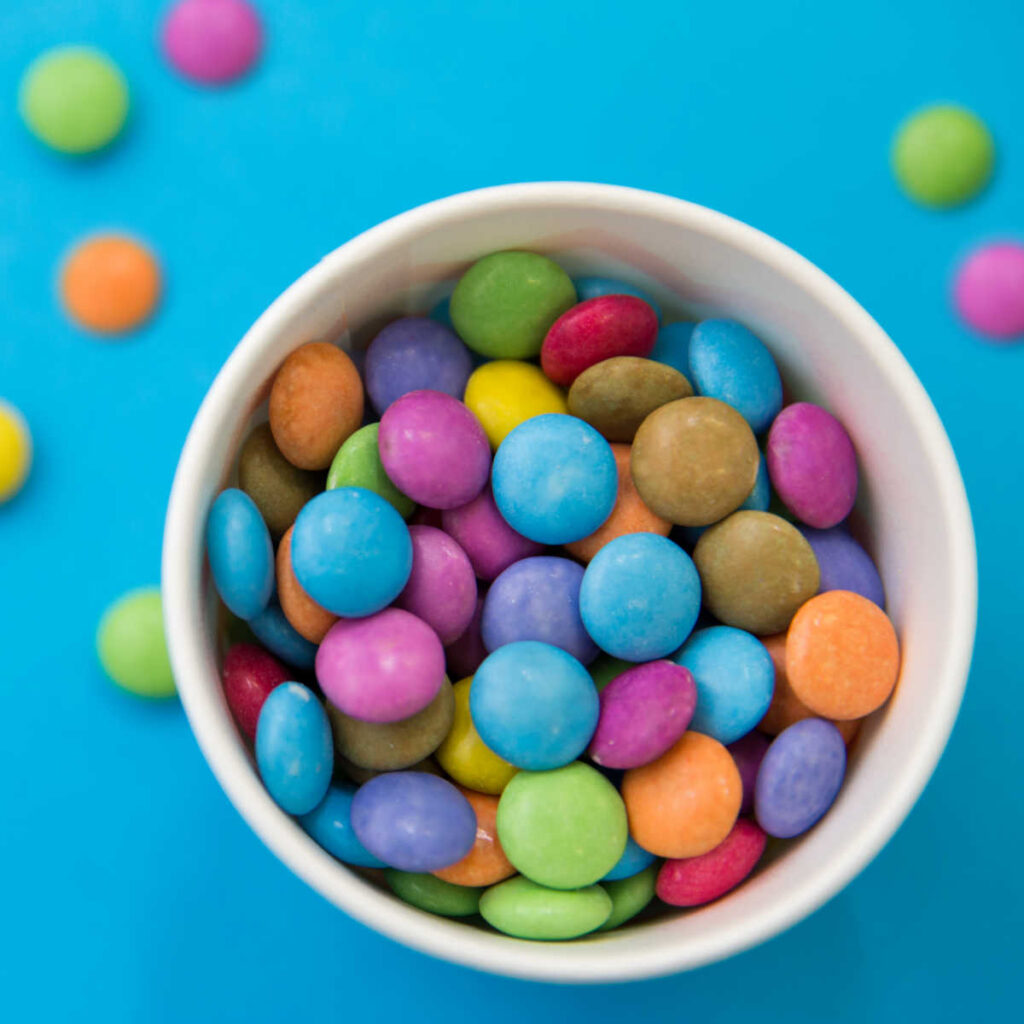
1. M&M's (1941, USA)
In 1941, Forrest Mars Sr. launched M&M's after observing soldiers during the Spanish Civil War eating small chocolate pellets encased in a hard sugar shell. This "tempered" coating prevented the chocolate from melting in tropical heat, making it an ideal snack for the military.
The slogan "melts in your mouth, not in your hand" was a literal product feature.
During World War II, the company sold the candies exclusively to the United States armed forces, and they became a standard part of American soldiers' C-rations.
Originally packaged in cardboard tubes, the sweets featured five primary colours: brown, yellow, orange, red, and violet. The iconic "m" was not actually printed on the shells until 1950, nearly a decade after their initial debut.
2. York Peppermint Pattie (1940, USA)
In 1940, Henry Kessler launched the York Peppermint Pattie at his York Cone Company in Pennsylvania. Unlike other chocolate creams of the era, which were often soft and gooey, Kessler designed his patty to be firm and crisp. To ensure every batch met his high standards, he implemented a "snap test"—if the peppermint centre did not break cleanly down the middle when snapped, it was rejected.
The treat originally had an extra-strong peppermint centre dipped in a dark chocolate coating. For the first thirty years of its history, the York Peppermint Pattie was only sold in Pennsylvania and surrounding Northeastern states. It did not become a national sensation until 1975, when the company was acquired and launched its famous "get the sensation" advertising campaign.
3. Junior Mints (1949, USA)
In 1949, James O. Welch launched Junior Mints in Cambridge, Massachusetts. He named the dark chocolate-covered peppermint creams after Junior Miss, a popular series of stories in The New Yorker that became a successful Broadway play and radio show.
The confectioners used a unique "cold-moulding" process to make the mint centers remained creamy while the chocolate shells stayed thin and crisp.
The candy gained rapid popularity as a cinema snack because the small, quiet boxes did not rustle like cellophane bags during films. The factory produces over 15 million individual Junior Mints every day to keep up with global demand.
Despite several company acquisitions over the decades, the recipe for the dimpled, dark chocolate coating and cool fondant centre remains unchanged from the 1949 original.
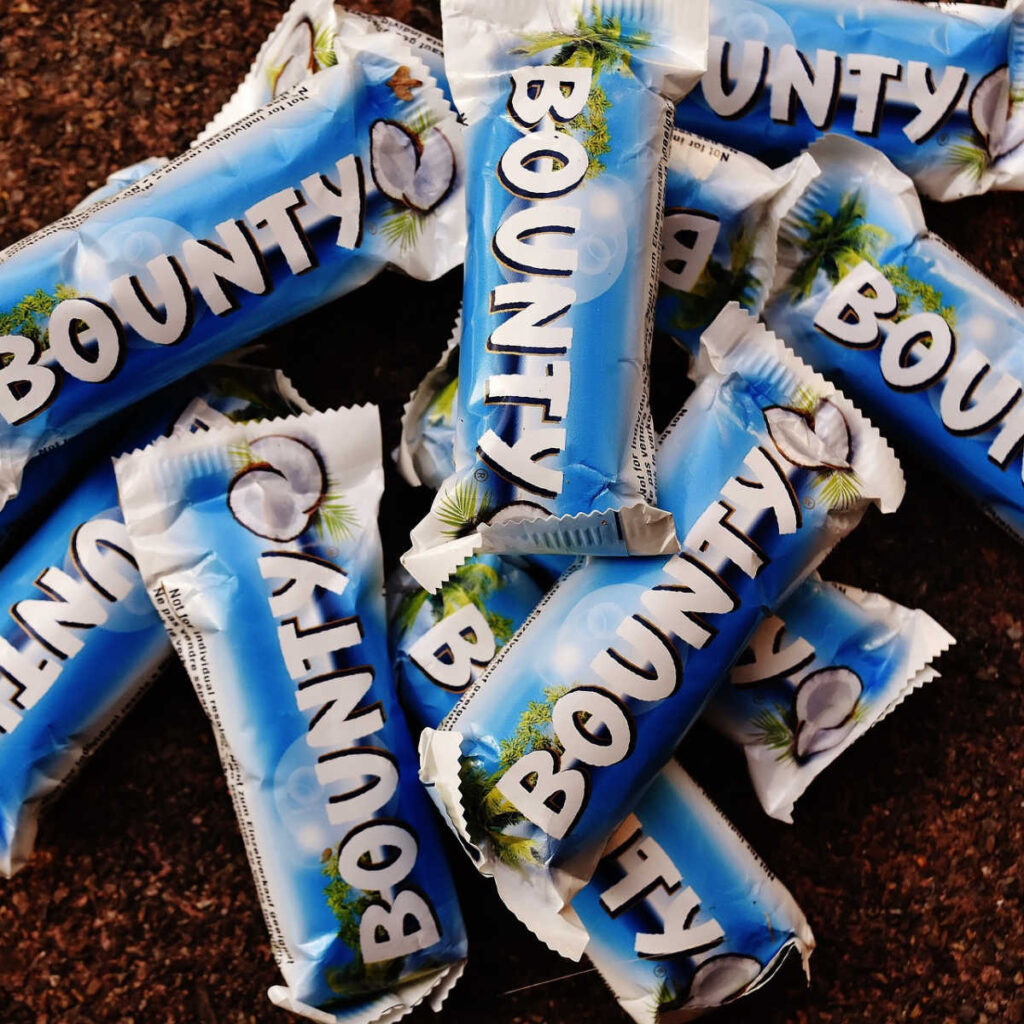
4. Bounty (1941, UK/Global)
In 1941, Mars launched the Bounty bar in the UK and Canada, which had a thick centre of sweetened, shredded coconut enrobed in milk chocolate. It arrived as a direct competitor to the American "Mounds" bar, which had dominated the coconut market since the 1920s. To differentiate the product, Mars focused on a "tropical" branding theme, using blue and white packaging decorated with palm trees to evoke the feeling of a paradise island.
The coconut is sourced mainly from the Philippines and Indonesia to keep consistent flavour that has remained virtually unchanged for over eighty years.
5. Bazooka Bubble Gum (1947, USA)
In 1947, Topps Chewing Gum Inc. launched Bazooka Bubble Gum in Brooklyn, New York. Named after the musical instrument made famous by comedian Bob Burns, the gum had a patriotic red, white, and blue wrapper to appeal to post-war American sentiment.
Each individual piece was a small, pink rectangular chunk of "double-strength" bubble gum. In 1953, the company added the iconic "Bazooka Joe" comic strips inside the wrappers, allowing kids to collect 75 different stories and trade them for prizes. By the end of the decade, the brand was a global staple, sold in over 100 countries with the comics translated into dozens of languages.
MORE SWEETS HISTORY
6. Polo Mints (1948, UK):
In 1948, Rowntree’s launched Polo Mints in the UK, marketed as "the mint with the hole." Though the company developed the idea and the machinery in 1939, the outbreak of World War II delayed the launch for nearly a decade.
Based loosely on the American "Life Savers," these peppermint treats were pressured into their iconic ring shape with over 75,000 pounds of force.
To ensure they remained fresh and portable, they were sold in aluminium foil-lined tubes. The brand became so successful that the factory in York eventually produced up to 150 million individual mints every single day.

7. Almond Joy (1946, USA)
Marketed as the "milk chocolate sister" to the Mounds bar, Almond Joy arrived on shelves in 1946 via the Peter Paul Candy Manufacturing Company. The creators wanted to offer a lighter alternative to their existing dark chocolate coconut treat, so they topped the coconut centre with two whole toasted almonds and smothered it in sweet milk chocolate.
This launch capitalised on the post-war availability of sugar and nuts, which had been strictly rationed just a year earlier. The bar’s massive success eventually led to one of the most famous advertising jingles in history: "Sometimes you feel like a nut, sometimes you don't."
8. Whoppers (1949, USA)
Overland Candy Company introduced Whoppers in 1949 as a rebrand of their earlier malted milk balls known as "Giants." These sweets had a porous, crunchy malt centre made from wheat flour and malted barley, covered in a thin coating of chocolate-flavoured candy. The 1949 relaunch focused on the "whopper" size of the treats compared to smaller competitors.
A key innovation for the brand was the 1950s introduction of the milk carton packaging, which prevented the delicate malt balls from crushing and made them a staple at concession stands. While the original flavour is malt and chocolate, the company eventually expanded the line to include strawberry and vanilla milkshake versions.
9. Smarties (1949, USA)
Distinct from the chocolate-filled discs sold in the UK, Smarties launched in the USA in 1949 under the Ce De Candy Company. Edward Dee, an English immigrant, founded the company in New Jersey using repurposed pellet-pressing machines from World War II to create these chalky, tablet-shaped sweets.
These kind of smarties were made with compressed dextrose and citric acid, which made their fruit flavours taste very sharp and zesty. Each classic transparent roll contains 15 tablets in six colours: white (orange-cream), yellow (pineapple), pink (cherry), green (strawberry), purple (grape), and orange (orange). Because the recipe contains no chocolate or animal products, the sweets have a long shelf life. In Canada and other regions, these same sweets are sold under the name Rockets to avoid confusion with the Nestlé chocolate brand of the same name.
MORE SWEETS HISTORY

Sweets & Chocolate History in the 1940s (1940 - 1949)
1940: The chocolate bar energy booster
As the war escalated, the British government officially recognised chocolate as an essential food for the military. It wasn't just a treat; it was high-energy fuel. Scientists worked to develop "Emergency Rations" that were designed to taste slightly less delicious than a normal bar so that soldiers wouldn't eat them all at once, but would save them for when they truly needed the energy.
1941: The invention of the heat-resistant chocolate bar
The US Army approached chocolate makers with a difficult challenge: create a bar that could withstand temperatures over 49°C (120°F) without melting. This led to the creation of "Tropical Chocolate." It stayed solid in the desert heat of North Africa, though soldiers famously joked that it tasted like a "boiled potato" because of the ingredients used to keep it from melting.
1942: The sweet's rationing starts
In the UK, the "Sweet Ration" officially began on July 26th. People were allowed only 2oz (about 57g) of sweets per week—roughly the weight of 1/2 modern chocolate bar. Shopkeepers had to use "ration books" and snip out coupons for every sale. Because stock was so low, many sweet shop windows were filled with empty boxes just to make the shop look like it was still in business.
1943: The first synthetic flavours
With fruit imports blocked by the war, chemists in the UK and USA perfected artificial fruit flavourings. Before 1943, most "orange" or "lemon" sweets used real oils or juices. When those became impossible to find, "synthetic" flavours took over, changing the taste of gummy sweets and hard candies into the bright, punchy flavours we still recognize today.
1944: Chocolate as currency
By 1944, Allied soldiers moving through Europe found that chocolate was more valuable than money. Hershey's bars and Cadbury tins were used to trade for fresh eggs, milk, or directions. For many children in liberated towns, the chocolate handed out by soldiers was the first time they had ever tasted cocoa in their entire lives.
1945: Chocolate helps to invent the microwave
In a lab in Massachusetts, engineer Percy Spencer was working on radar technology when he noticed that a chocolate bar in his pocket had completely melted. This accidental discovery proved that "microwaves" could cook food rapidly. This moment eventually led to the invention of the microwave oven, which would change how we bake and melt chocolate in kitchens forever.
1946: The invention of chocolate - hazelnut spread
After the war, cocoa was still incredibly expensive and hard to find. In Italy, a pastry maker named Pietro Ferrero decided to stretch his tiny supply of cocoa by mixing it with toasted hazelnuts, which were plentiful in his region. He called the paste "Supercrema"—the early version of what eventually became Nutella. It was a genius way to make a "chocolate" treat without needing much chocolate.
1947: The chocolate bar strike
In Canada, a massive "Chocolate War" broke out when the price of an average chocolate bar rose from 5 cents to 8 cents. Thousands of school children went on strike, marching through streets with signs that read "Don't be a Sucker!" and "8 cents is too much!" The protest was so big that people actually thought it was a secret political uprising, and it remains one of the largest "kid-led" protests in history.
1948: The Pez packaging changes
Originally invented in Austria in the 1920s as a peppermint for smokers, the Pez dispenser was redesigned in 1948 to look like a cigarette lighter. The goal was to encourage adults to quit smoking by "flicking" a mint instead. It wasn't until a few years later that they added the famous character heads and fruity flavours to market them to children.
1949: Attempts to end the sweet rationing
On April 24th, 1949, the British government tried to end sweet rationing. They expected things to go smoothly, but they vastly underestimated how much people missed sugar. Within hours, shops were stripped bare by "sugar-starved" crowds. The demand was so overwhelming that the government had to bring rationing back just four months later! It didn't fully end until 1953.
This blog post was originally written on 26 June 2016 and last updated on 31 January 2026



Leave a Reply